
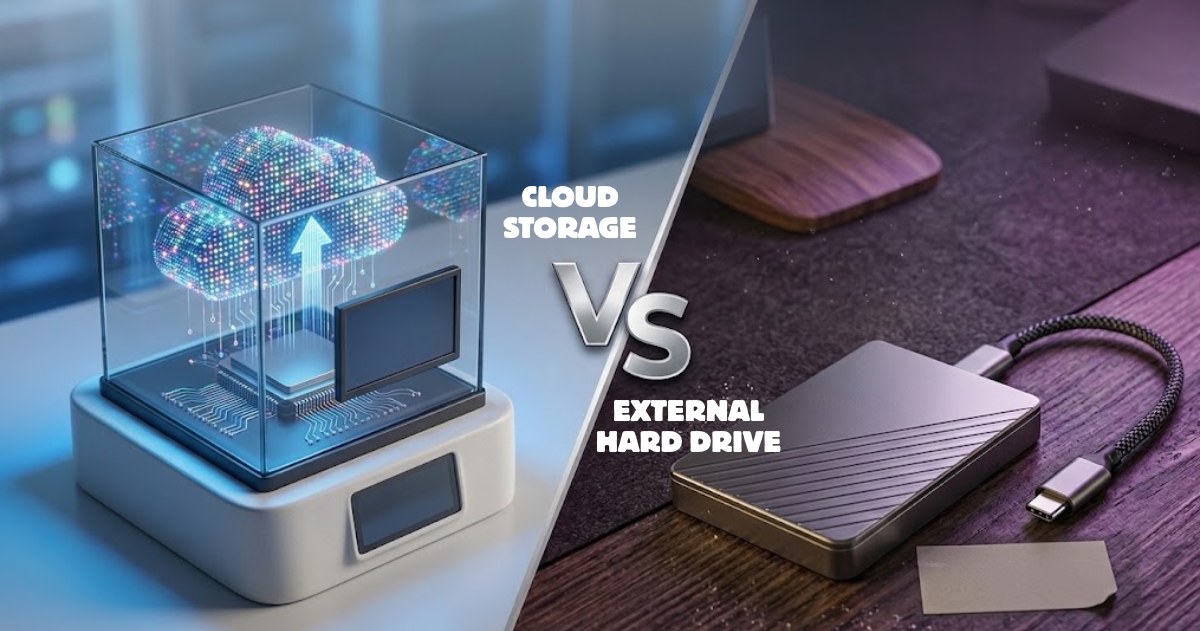
Choosing between cloud storage vs. external hard drive backups comes down to balancing recurring subscription costs against the physical vulnerabilities of portable hardware. An external hard drive offers massive local capacity for a single payment, while cloud providers charge ongoing fees in exchange for off-site protection and automated synchronization.
Most people approach data storage looking for a single winner. In practice, relying exclusively on an external drive risks catastrophic data loss if that drive drops or degrades, while depending entirely on cloud storage means paying indefinitely to rent digital space. Examining the financial costs, hardware lifespans, and operational friction of both formats shows where each fits into your setup.

5-Year Cost Comparison: Hardware Purchase vs. Cloud Subscriptions
An external hard drive provides substantial upfront cost savings over five years compared to ongoing monthly cloud storage subscriptions. Buying physical storage is a one-time transaction, whereas cloud platforms require continuous monthly or annual payments to maintain access to your files.
To see the financial difference, look at standard storage capacities over a typical five-year ownership cycle:
- Portable hard drive (2TB): A quality 2TB external solid-state drive or mechanical drive costs between $60 and $130 as a single retail purchase. After paying that initial purchase price, your running cost for the remainder of the five-year period is zero.
- Commercial cloud storage (2TB): Standard cloud tiers from mainstream providers average $9.99 per month, or roughly $100 per year when billed annually. Over five years, that subscription adds up to approximately $500 for the same 2TB capacity.
The financial trade-off is clear: you pay nearly four to five times more for cloud storage over five years. However, that price premium does not just buy raw digital capacity; it pays for continuous server maintenance, enterprise hardware upgrades, physical facility electricity, and software engineers maintaining data centers on your behalf. Managing these recurring software commitments requires careful planning, much like we detailed in our guide on [How to Build a $1,000 Emergency Fund When You’re Living Paycheck to Paycheck], where keeping an eye on recurring expenses keeps your overall budget healthy.
Physical Drive Failure Rates and the Reality of Data Rot
Physical drives inevitably fail over time due to mechanical wear, component degradation, and accidental physical impacts. Storing critical family photos or work archives on a single external drive creates a dangerous point of failure that will eventually result in lost data.
Every physical storage medium faces specific operational risks:
- Mechanical Hard Disk Drives (HDDs): Traditional external drives rely on motorized spinning platters and magnetic read heads floating fractions of a millimeter above the disk surface. A short drop from a desk while spinning can cause a head crash, instantly scraping the platter surface and destroying stored data.
- Solid-State Drives (SSDs): Portable SSDs eliminate moving mechanical components, making them resistant to drops and rough travel. However, they rely on electronic flash cells that degrade with repeated read and write cycles. Leaving an SSD unpowered in a desk drawer for several consecutive years can also lead to bit rot, where electrical charges gradually leak from the cells, corrupting stored files.
- Accidental loss and environmental hazards: A portable drive kept in a laptop sleeve or desk drawer is vulnerable to household water leaks, fire, power surges, or simple theft.
When a physical drive fails outside of its warranty, recovering files through clean-room forensic services routinely costs anywhere from $500 to over $2,000, with no guarantee that files can be salvaged.

Save Big on Verified Software Today
Looking for verified coupons and exclusive vouchers? Check out our live tested deals before subscribing.
⚡ Claim Active Deals (Up to 80% Off)Article Toolkit
Find this teardown useful? Share it with fellow developers and engineers.